
What a Democratic Congress Means for Your Portfolio
Democrats now control both chambers while the President keeps the veto. History suggests that long-term plans matter more than the headlines.
Investors who checked their accounts on November 4 and again on November 5 saw two very different sessions. On Wednesday, the Dow Jones Industrial Average gained more than 1,500 points as results made clear that Democrats would take control of Congress.1 On Thursday, the mood reversed. The Dow closed down 1,833 points, or about 3.4%, the S&P 500 fell 4.4%, and the Nasdaq Composite dropped 5.5%, moving it into correction territory, meaning a decline of more than 10% from its recent high.2 For many clients, that whiplash raises a practical question: does this election change my plan?
Based on what is known today, the election changes the political backdrop more than the economic forces that drive long-term returns. This article looks at what a divided Washington can and cannot realistically accomplish, how markets have behaved after past midterm elections, and why staying anchored to a long-term plan remains a sound approach.
Why Now: What the Election Decided
Democrats won control of both chambers in the November 3 election. In the Senate, Democrats and the two independents who caucus with them held 55 seats to 44 for Republicans as of November 12, with the Alaska race still uncalled.3,4 Democrats flipped eight seats: Iowa, Kansas, Maine, Mississippi, North Carolina, Ohio, South Carolina, and Texas.3,4 In the House, Democrats had won 255 seats to 169 for Republicans, well beyond the 218 needed for a majority, with 11 races still to be called.5
The result returns Washington to divided government. President Trump keeps the veto, and he has said he would block Democratic legislation. The two parties will have to cooperate on some issues and clash on others, and that combination shapes which policies move forward and how fast.
Morningstar’s research argues that the market impact of politics is often overstated. The firm points to the 2024 “Trump trades,” when small caps, financials, and energy rallied on expected tax cuts and deregulation. Many of those moves reversed within about a year, once tariffs and other policies took shape.6,7
What Changed, and What Did Not
What changes in 2027. The clearest change is in oversight and nominations. Democrats gain committee control and the authority to investigate, which typically brings more oversight hearings. With a Senate majority, Democrats will also control the confirmation process for the President’s nominees.
What does not change. Divided government makes sweeping new legislation difficult, since any bill must be signed and the President has said he would veto Democratic priorities. Congress also has to pass 12 annual appropriations bills to keep the government funded, and those must-pass items typically require bipartisan cooperation. Whether affordability priorities become law in 2027 depends largely on what a veto-holding President will sign.
The practical result is a Congress that spends more time investigating and confirming than legislating. Policies most likely to move markets, including tax, trade, and regulation, can still change through executive action, agency rules, and the courts.
What History Says About Elections and Markets
The Motley Fool’s analysis of market history since 1874, based on Robert Shiller’s historical stock market data, found that the S&P 500 rose in the 12 months following 32 of 38 midterm elections, averaging a total return of 14%, measured from November of each midterm year.8
Breaking the results down by configuration gives a more specific view. Midterms that produced the arrangement the country is now entering, divided government under a Republican president, were followed by positive 12-month returns in 13 of 14 cases. That record describes the past and does not indicate how markets will perform after 2026.
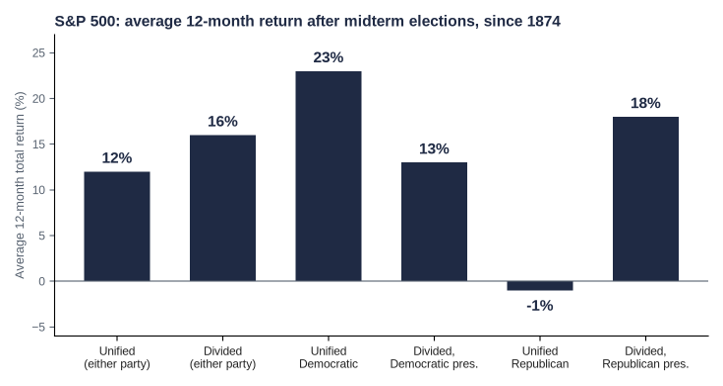
| Government configuration | Elections | Avg. 12-mo. return | Share positive |
| Unified government (either party) | 15 | 12% | 73% |
| Divided government (either party) | 23 | 16% | 91% |
| Unified Democratic government | 8 | 23% | 100% |
| Divided, Democratic president | 9 | 13% | 89% |
| Unified Republican government | 7 | -1% | 43% |
| Divided, Republican president | 14 | 18% | 93% |
Small sample sizes limit what these averages can prove.
Two other points add context. First, the opening three quarters of a midterm year have historically been weak, with the S&P 500 falling on average 0.9%, according to J.P. Morgan’s historical data, while the fourth quarter has averaged a 6.4% gain as election uncertainty resolves.9 Second, the November 5 sell-off centered on AI-linked and data-center shares, which investors feared a Democratic Congress could slow.2 A concentrated theme can drive markets even when the policy story is unclear.
Invesco reached a similar conclusion across configurations. Markets have performed well under single-party rule and several forms of divided government, and staying invested across all configurations has historically beaten investing only when a favored party holds power.10
Three Questions Clients Are Asking
Do markets do better or worse under divided government? The historical edge is real but modest and not a guarantee. The samples are small, and differences between configurations are smaller than typical year-to-year swings.
Markets have generally done well across political arrangements, which argues against building a portfolio around one election.
Should I change my portfolio because of the election? For most investors, not because of the election alone. David Kelly, chief global strategist at J.P. Morgan Asset Management, said the immediate post-election rally has run its course and that investors are refocusing on pre-existing concerns, such as how the AI buildout will be financed. His longer-term outlook has not changed, and his advice was direct: do not try to time or day-trade the market.11
J.P. Morgan Asset Management also publishes a 12-month outlook for the S&P 500. Strategist forecasts reflect assumptions that may not be realized, do not predict any investor’s results, and are best treated as one input among many.
What policy changes are realistic in 2027? Expect fewer sweeping laws and more oversight, with hearings, confirmation fights, and negotiated spending bills. Major legislation requiring both a new statute and a presidential signature faces a steep path.
Three Planning Reminders
- Stay diversified. A portfolio concentrated in one theme, such as AI, can fall hard even when the policy story is uncertain. Broad diversification reduces the damage when any one forecast is wrong.
- Set target allocations and rebalancing bands in advance. That gives a disciplined response that does not depend on predicting the next headline.
- Revisit your goals. Review time horizon, cash needs, and risk tolerance. A new job, a home purchase, or a family change is a better reason to adjust a plan than an election result.
Elections will keep arriving on schedule, and markets will keep reacting in the short term. The more useful question is whether your plan can withstand the volatility that comes with normal market cycles. That is worth revisiting with your financial professional.
Sources
- ABC News, “Dow closes up 1,500 points as Democrats take control of Congress,” Nov. 4, 2026. https://abcnews.com/Business/dow-surges-1000-points-democrats-control-congress/story?id=137842989
- CNBC, “Stock market news for Nov. 5, 2026”. https://www.cnbc.com/2026/11/04/stock-market-today-live-updates.html
- NPR, “2026 election: Democrats win full control of Congress”. https://www.npr.org/2026/11/03/g-s1-149526/2026-midterms-congress-balance-of-power
- NPR, “Democrat Scott Colom wins Mississippi Senate race,” Nov. 11, 2026. https://www.npr.org/2026/11/11/g-s1-151688/mississippi-senate-race-scott-colom
- Associated Press, “2026 U.S. House Election Results,” updated Nov. 12, 2026. https://apnews.com/projects/elections-2026/united-states-results/us-house-results/
- Morningstar Indexes, “Which ‘Trump Trades’ Paid Off and Which Ones Missed the Mark”. https://indexes.morningstar.com/insights/perspective/blt54e2851e450c6f73/which-trump-trades-paid-offand-which-ones-missed-the-mark
- Morningstar, “Why the market implications of the midterm elections aren’t as clear as they seem”. https://www.morningstar.com.au/markets/why-market-implications-midterm-elections-arent-clear-they-seem
- The Motley Fool midterm market analysis, as reported in “The midterms are coming. Here’s what the stock market has actually done before and after since 1874,” Charlotte Observer, Oct. 8, 2026. https://www.charlotteobserver.com/news/business/article317542819.html
- J.P. Morgan, “How do midterm elections affect the stock market? What history shows”. https://www.jpmorgan.com/insights/markets-and-economy/economy/how-does-the-stock-market-perform-during-midterm-election-years
- Invesco, “How could the midterm results impact economic growth?”. https://www.invesco.com/us/en/insights/midterm-elections-economic-growth.html
- J.P. Morgan Wealth Management, “‘A hangover from the big post-election rally.’ What comes next for markets?” Nov. 9, 2026. https://www.chase.com/personal/investments/learning-and-insights/article/2026-midterm-election-stock-market-rally-and-correction
Important Disclosures
This material is published and distributed by Financial Media Exchange, LLC (“FMeX”) for informational and educational purposes only. It is not personalized investment advice, an offer or solicitation, or a recommendation to buy, sell, or hold any security, investment product, or investment strategy. This material does not consider any investor’s objectives, financial situation, risk tolerance, or particular needs.
Financial Media Exchange, LLC is not a registered investment adviser or broker-dealer. No advisory fee, product fee, commission, or other charge is associated with this educational communication. Unless expressly disclosed in the article, FMeX has not received compensation from an issuer, investment manager, broker-dealer, or other market participant for discussing a security, product, or strategy in this material, and FMeX has no material financial interest in any specifically discussed security or product.
Investing involves risk, including possible loss of principal. Security prices, interest rates, yields, and market conditions can change, and investment returns are not guaranteed. Past performance is not indicative of future results. Current performance may be higher or lower than historical performance. Market indexes are unmanaged, do not reflect fees, expenses, or taxes, and cannot be invested in directly.
Statements concerning market conditions, economic data, or possible future outcomes reflect information and expectations available as of the publication date. Actual outcomes may differ materially. Information is obtained from sources believed to be reliable, but its accuracy, completeness, and timeliness are not guaranteed.
Investors should review relevant offering documents and consult an appropriately qualified financial, tax, or legal professional before making an investment decision. Questions regarding this educational material may be directed to FMeX at info@fmexc.com. Additional information is available at www.fmexc.com.