
Reviewing Your Investment Income After the Fed’s Rate Increase
Higher yields offer more income options. The next step is understanding how those options fit your goals, time horizon and risk tolerance.
KEY TAKEAWAYS
- On Sept. 16, 2026, the Federal Open Market Committee (FOMC) voted 12–0 to raise the federal funds target range by 25 basis points to 3.75%–4.00%, citing elevated inflation.
- FOMC participants’ median year-end 2026 federal funds rate projection of 4.1% suggests possible further tightening. Projections are not commitments.
- On Oct. 6, 2026, Treasury par yields were 4.21% for three months, 4.79% for two years and 5.27% for 10 years.
- The September jobs report underscores the economic uncertainty surrounding income planning.
- The rate outlook can change quickly. Income planning should reflect individual needs, rather than depend on a forecast.
The Question Has Changed
During periods of low interest rates, some savers considered riskier investments in search of higher income. Higher rates have expanded the options available. On Sept. 16, 2026, the Federal Open Market Committee unanimously raised the target range for the federal funds rate by 25 basis points to 3.75%–4.00%, citing elevated inflation.
FOMC participants’ updated projections put the median year-end 2026 federal funds rate at 4.1%, suggesting possible further tightening. These projections are not commitments. Meeting minutes released Oct. 7 indicated that most participants considered another increase likely to be appropriate before year-end, while emphasizing that future decisions would depend on incoming information.
What Higher Rates Mean for Your Income
Treasury yields provide a dated snapshot of income opportunities. On Oct. 6, 2026, the Treasury’s daily par yield curve showed 4.21% for the three-month bill, 4.79% for the two-year note and 5.27% for the 10-year note. For investors, including those ages 27 to 57, higher yields may increase income on cash reserves, emergency funds and short-term savings, depending on the account or investment selected.
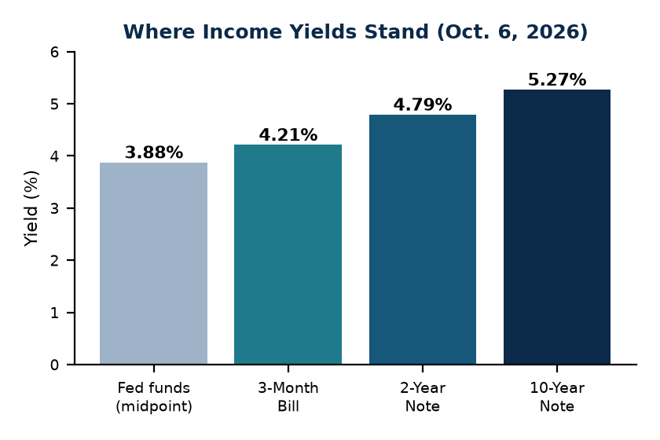
Figure 1. Federal funds target midpoint and selected Treasury par yields, Oct. 6, 2026. The midpoint is a policy reference, not an investor yield. Sources: U.S. Department of the Treasury; Federal Reserve.
Higher yields also bring trade-offs. When interest rates rise, existing bond prices generally fall; longer-maturity bonds are typically more sensitive, all else equal. Borrowing costs may also rise for mortgages, auto loans and credit cards. An income review therefore considers both investments and debt.
Why Forecasts Are an Uncertain Foundation
Yields can respond quickly to economic data. CNBC’s cited Oct. 2 report described the September jobs report as weaker than expected: the 10-year Treasury yield fell to about 5.18% in morning trading, and CME FedWatch pricing indicated an 84% probability of an October rate hold. The U.S. Bureau of Labor Statistics reported a payroll gain of 29,000 and an unemployment rate of 4.2%, describing both as little changed. The cited market report indicated that yields later reversed and closed higher that day. Such shifts illustrate the limits of relying on a rate forecast for income planning.
Five Questions to Review With Your Advisor
- What is each dollar for? Distinguish money needed within 12 months, funds for goals one to five years away and long-term savings. Each time horizon may call for a different approach.
- How does your cash yield compare? Checking accounts and low-rate savings accounts may earn less than short-term Treasuries. A comparison should also consider liquidity, deposit insurance, taxes and costs.
- How much interest-rate risk can you tolerate? The cited Treasury yields were higher at longer maturities, but longer-term bond prices are generally more sensitive to rate changes. Staggered maturities in a bond ladder may provide opportunities to reinvest over time, while retaining interest-rate and reinvestment risk.
- Is yield masking risk? High-yield bonds and high-dividend stocks may offer more income, but credit and market risks can become more pronounced during an economic slowdown. Total return includes income and changes in market value; yield alone does not capture the outcome.
- Are taxes and debt part of the picture? Treasury interest is generally exempt from state and local income taxes, while municipal bond interest may qualify for federal tax exemptions, subject to exceptions. Reducing variable-rate debt may lower interest costs. Any comparison with investment income should account for taxes, loan terms and liquidity needs.
Matching Tools to Time Horizons
| Time Horizon | Income Options to Discuss |
| 0–12 months | High-yield savings accounts, money market funds, Treasury bills |
| 1–5 years | Certificates of deposit (CDs), short- and intermediate-term Treasuries, bond ladders |
| 5+ years | Diversified bond funds, dividend-paying stocks |
Illustrative examples only, not recommendations. Suitability depends on individual circumstances; risks and liquidity vary by product.
Putting the Review in Perspective
Higher rates can expand income options, but yield is only one part of the decision. A review begins with goals, time horizons and risk tolerance, then considers investments in that context. A plan based on individual needs may help frame decisions as rates change, although it cannot eliminate investment risk. A discussion with a financial advisor can help assess how an income strategy fits those needs.
Sources
- Board of Governors of the Federal Reserve System, “Federal Reserve issues FOMC statement,” Sept. 16, 2026. https://www.federalreserve.gov/newsevents/pressreleases/monetary20260916a.htm
- Board of Governors of the Federal Reserve System, Summary of Economic Projections, Sept. 16, 2026. https://www.federalreserve.gov/monetarypolicy/fomccalendars.htm Direct release: https://www.federalreserve.gov/monetarypolicy/fomcprojtabl20260916.htm
- U.S. Department of the Treasury, Daily Treasury Par Yield Curve Rates, Oct. 6, 2026. https://home.treasury.gov/resource-center/data-chart-center/interest-rates/TextView?type=daily_treasury_yield_curve&field_tdr_date_value=2026
- CNBC, “10-year Treasury yield ticks higher despite weaker-than-expected jobs report,” Oct. 2, 2026 (intraday figures and CME FedWatch pricing). https://www.cnbc.com/2026/10/02/treasury-yields-bonds-nonfarm-payrolls.html
- CNBC, “Fed approves interest rate hike, signals one more to come this year,” Sept. 16, 2026. https://www.cnbc.com/2026/09/16/fed-rate-decision-september-2026.html
- CME Group / Econoday, “US: FOMC Minutes,” Oct. 7, 2026. https://www.cmegroup.com/education/events/econoday/625685
- U.S. Bureau of Labor Statistics, The Employment Situation — September 2026, Oct. 2, 2026. https://www.bls.gov/news.release/empsit.nr0.htm
Important Disclosures
The federal funds target midpoint (3.875%, rounded to 3.88%) is a policy reference, not a yield available to investors. Treasury par yields are annualized market references, not guaranteed total returns or quotes for a specific investment.
Savings deposits and bank CDs at FDIC-insured banks are insured only within applicable coverage limits. Money market funds are investments, are not FDIC-insured and can lose value; their yields change, and liquidity fees may apply to certain funds. Bank CDs may impose early-withdrawal penalties, while brokered CDs may lose value if sold before maturity. Treasury prices can fluctuate before maturity. Bond funds do not promise repayment of principal on a fixed maturity date. Dividends may be reduced or eliminated, and stock prices can decline. Comparisons should account for liquidity, insurance, taxes, fees and expenses. Fund expenses and advisory or transaction charges reduce returns. Review a fund’s prospectus for its risks, fees and expenses before investing.
This material is for informational and educational purposes only. It is not intended as investment, tax or legal advice or a recommendation to buy or sell any security. Investing involves risk, including possible loss of principal. Bond prices generally fall when interest rates rise; fixed-income investments are subject to interest-rate, credit, inflation and reinvestment risk. Yields and market data are as of the dates cited and are subject to change. Projections and market-implied probabilities do not guarantee future results. Treasury securities are backed by the U.S. government for timely payment of principal and interest; holding them to maturity does not eliminate price fluctuations before maturity. Consult your financial professional about your individual situation.
Financial Media Exchange publishes and distributes this material for informational and educational purposes only. It is not intended as investment advice or a recommendation to buy or sell any security. Financial Media Exchange does not provide advisory services or receive compensation based on the performance of any index or security referenced. This communication is not intended as a forecast of future events or a guarantee of future results.
NO MATERIAL CONFLICTS: Financial Media Exchange LLC (“FMeX”) provides third-party educational content to registered investment advisers through a subscription-based service. FMeX receives subscription fees for access to its content; those fees are not tied to any security, issuer, investment product, sector, strategy or transaction discussed in this newsletter. FMeX has identified no material financial interest or other conflict that would reasonably be expected to influence this content.
Investing involves risk, including possible loss of principal. Past performance does not guarantee future results. Investment returns and principal value fluctuate, and investors may gain or lose money when selling an investment. The income and inflation figures are arithmetic illustrations based on stated assumptions, rather than actual investment performance or forecasts. Assumed payment rates are not guaranteed. The information presented is believed to be reliable, but its accuracy is not guaranteed. Readers should consult their own financial professional before making investment decisions.
No regulator has approved or endorsed this content. Investments and strategies are discussed for general education, rather than as personalized advice or recommendations to buy or sell a security. The applicability of marketing rules depends on how the communication is used and distributed.